Beyond the Scorecard: The Psychological Toll of Shubman Gill's Comeback Failure in Vijay Hazare Trophy
The Immediate Setback: A High-Profile Stumble
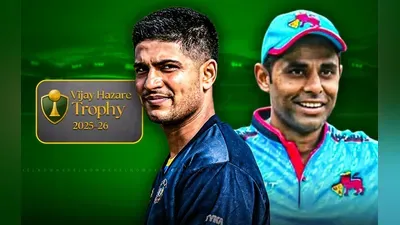
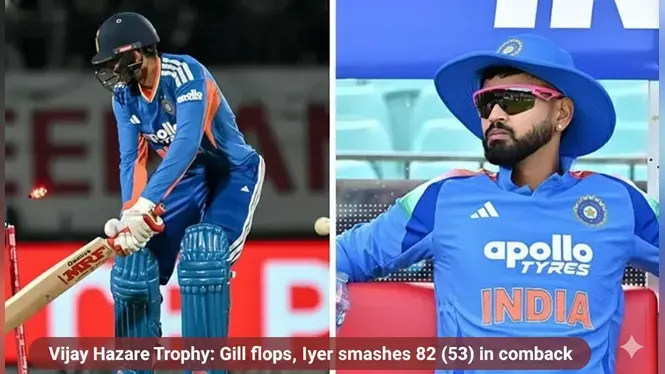
When Shubman Gill walked onto the Vijay Hazare Trophy field after his injury layoff - his first appearance in the tournament in six years - the weight of expectation hung heavy. India's ODI captain faced his first competitive match since a toe injury forced him out of India's fifth T20I against South Africa last month. What followed was a brutal 12-ball struggle that ended with Gill trudging back to the pavilion with just 11 runs against his name - dismissed by Goa's 33-year-old pacer Vasuki Koushik - a performance that extended his worrying slump of seven ODIs without a fifty.
The optics couldn't have been worse. While Gill faltered, his contemporary Shreyas Iyer scripted a fairytale return from a spleen injury just miles away. Iyer's blistering 82 off 53 balls for Mumbai created a stark contrast that amplified Gill's struggle. This wasn't just another low score - it was a high-profile failure under the microscope of national leadership and public expectation during the sixth round of the 2025-26 Vijay Hazare Trophy on January 6, 2026.
The Psychological Perfect Storm
Gill's Vijay Hazare comeback represents a case study in the invisible pressures facing modern athletes. Three psychological factors converged to create this high-stress environment:
1. The Injury Comeback Paradox
Returning athletes face contradictory pressures - the urgency to prove fitness clashes with the need for gradual reintegration. Gill's toe injury created physical uncertainty that inevitably bleeds into mental doubt. Each defensive stroke and mistimed shot becomes magnified through the lens of recovery.
2. Leadership Weight
As India's ODI captain, Gill shoulders dual responsibility - personal performance and team leadership. The Vijay Hazare appearance wasn't just about runs; it was about reasserting authority after recent team struggles. Every failure now carries implications beyond individual statistics.
3. The Social Media Amplifier
Within minutes of his dismissal, Gill became trending fodder across platforms. Article 8's mention of "merciless trolling" reveals how modern athletes face instant, global judgment - a phenomenon unknown to previous generations. This digital scrutiny transforms temporary setbacks into lasting narratives.
The Resilience Playbook: How Athletes Bounce Back
While Gill's struggle dominates headlines, cricket history reveals proven psychological strategies for overcoming such setbacks:
Compartmentalization Technique
Successful comebacks require separating past failures from present opportunities. Virat Kohli's 2022-23 resurgence demonstrated this - treating each innings as a fresh canvas rather than a continuation of previous struggles.
Process Over Outcome Focus
Shreyas Iyer's successful return from a spleen injury in the same tournament illustrates this principle. By concentrating on shot execution rather than scoreboard pressure, he converted his comeback into a statement innings.
Support System Activation
Elite athletes like Steve Smith have credited personal support networks for navigating form slumps. Gill's access to BCCI sports psychologists and veteran mentors provides tools to reframe this setback.
The Long Game: Historical Precedents
Cricket's archives offer perspective on comeback trajectories. Sourav Ganguly's 2006 return after Chappell-gate controversy saw initial struggles before Test-match redemption. More recently, Rishabh Pant's phoenix-like rise from career-threatening accident shows modern sport's capacity for dramatic turnarounds. The same Vijay Hazare round witnessed Hyderabad's Aman Rao joining this narrative with a historic 200 not out against Bengal as Hyderabad piled up 352/5 in 50 overs.
Gill's current statistics - while concerning - mirror Kohli's 2014 England tour struggles (134 runs across 10 innings) that preceded his transformation into a modern great. These historical parallels remind us that athlete psychology operates on nonlinear timelines.
The Path Forward: Rebuilding Mechanisms
For Gill to navigate this challenge, cricket psychologists suggest three actionable steps:
1. Micro-Target Setting
Breaking down performances into smaller, controllable metrics - contact quality, decision-making percentages - rather than fixating on runs. This technique helped Rohit Sharma overcome his early career inconsistency.
2. Media Narrative Management
Developing selective engagement strategies to avoid toxic feedback loops. Many current players employ social media managers during rough patches to maintain mental equilibrium.
3. Competitive Contextualization
Viewing the Vijay Hazare Trophy as one data point in a larger comeback journey. KL Rahul's approach during his 2022 rehabilitation - treating domestic cricket as preparation rather than judgment - offers a relevant template.
The Bigger Picture: Cricket's Mental Health Evolution
Gill's struggle coincides with cricket's growing awareness of psychological pressures. The BCCI's increased investment in mental health resources reflects a sport gradually acknowledging that elite performance requires emotional infrastructure as much as technical coaching.
This incident highlights why players like Glenn Maxwell and Ben Stokes have championed mental health breaks. As cricket's schedule intensifies, the ability to manage psychological wear-and-tear becomes as crucial as handling physical workloads.
Conclusion: Failure as Foundation
Shubman Gill's Vijay Hazare comeback after six years away from the tournament, while statistically disappointing, provides invaluable insight into elite sport's psychological dimensions. How he responds to this setback could define his leadership era more significantly than any century. History reminds us that today's failure often plants seeds for tomorrow's resurgence - provided the mental framework exists to nurture them.
As Gill prepares for his next innings, cricket's true students will watch not just his footwork or bat swing, but the psychological resilience underpinning them. In modern sport, where every failure trends globally within minutes, the real victory lies in mastering the mental game that happens far from public view.